


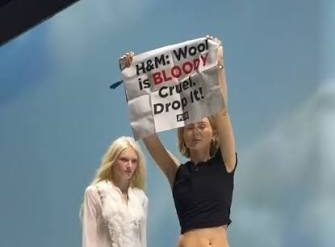
Fashion week is often no stranger to headline-grabbing photos, with supermodels and well-renowned designers from all over the world guaranteeing paparazzi and images that will be strewn across the papers and social media.
However, at New York Fashion Week this month, the picture became rather less controlled. During COS’s show on September 13, two PETA protesters entered the runway carrying a message on wool and leading to a confrontation that followed that saw Steven Kolb, then chief executive and president of the Council of Fashion Designers of America (CFDA), stepping down from his role of 20 years.
The same then happened in London, where on September 17, three PETA supporters separately entered H&M’s London Fashion Week show at Olympia, carrying signs calling on the retailer to drop wool, before the demonstrators were escorted from the runway.
The stunts have generated a large amount of attention online and also created conversation about the division between animal welfare and sustainability in fashion.
PETA says its current campaign is focused on H&M Group and the use of wool that it alleges is obtained through animal rights abuses. But at the centre of PETA’s dispute is NATIVA, a certification and traceability programme used by H&M Group and other fashion companies.
So what exactly is NATIVA wool, and why does PETA say its certification is not enough?
What is NATIVA wool?
Nativa is a branded sourcing and certification programme developed by Chargeurs Luxury Materials, now part of Chargeurs’ Luxury Fibers business.
NATIVA’s mission says it was developed to provide traceability and environmental, social and animal-welfare requirements across the wool supply chain.
Chargeurs describes it as a programme covering the journey from farm through processing, spinning, knitting or weaving and manufacturing, claiming it is the first global wool brand to provide Blockchain traceability from farm to consumer, allowing brands to show the entire journey of their garments.
https://www.youtube.com/shorts/fiNb972RwEw
The company reports its wool is not sourced from one country, but certified farms in Australia, New Zealand, South Africa, North America, Uruguay and Argentina. Greasy wool is then transported to certified combing mills, before being spun into yarn and made into fabric or finished products.
Among other sustainability benefits to its methods, the business quotes reduced water usage, the widely recyclability of its wool and biodegradability in a sector suffering from water stress and clothing pollution.
It’s website also highlights the long list of brands and retailers that publicly sells garments made from NATIVA wool such as Reformation, Stella McCartney and Gucci.
Why is PETA protesting?
PETA’s argument is straightforward: it does not believe there is such a thing as cruelty-free wool. The charity’s campaign intensified after a PETA Asia undercover investigation at a South African wool operation that, according to PETA, was NATIVA-certified and connected to H&M Group’s supply chain.
PETA says investigators filmed workers kicking sheep, striking them with shearing equipment and a piece of wood, dragging lambs by their legs and cutting animals during shearing. It also says one lamb was found with a maggot-infested wound and that a dead lamb was documented.
PETA founder Ingrid Newkirk said:
“These protests highlight that every wool garment is a product of suffering.”
She added that PETA Asia’s investigation showed sheep being “beaten, kicked in the head, yanked by their legs, and cut during shearing”.
PETA says its wider investigations are the reason it rejects the idea that changing suppliers or adding another certification is sufficient. The organisation says its entities have investigated more than 150 wool-producing operations across four continents and that every investigation uncovered abuse.
However, H&M has refuted the allegations. In a statement, the retailer said animal welfare was “very important” to it and that “no animal should be harmed to make our products”.
“We respect everyone’s right to express their opinions, and we believe that everyone should be treated with care and respect,” a spokesperson said.
“We rely on some of the strictest third-party standards and certifications when sourcing animal-derived fibers for our products.
“All virgin wool is either certified by Textile Exchange’s Responsible Standard, or comes from certified recycled sources, and we take any breaches of the third-party standards and certifications we rely on very seriously.”
It is not the first time PETA has used this type of campaign before. Its long-running anti-fur campaign helped put animal-derived materials at the centre of fashion’s ethical debate. Gucci announced a fur-free policy in 2017, Chanel banned fur and exotic skins in 2018, and Kering announced that all of its fashion houses would go fur-free in 2021.
PETA itself ended its famous “I’d Rather Go Naked Than Wear Fur” campaign in 2020, arguing that fur had moved from the mainstream of fashion and that its campaigning focus should increasingly turn to leather and wool.
This time, PETA says its investigations go beyond “one farm, supplier, or certification scheme.”
“In the past, brands have cut ties with wool suppliers following PETA revelations. But simply switching suppliers does not solve the problem,” said a spokesperson. “PETA entities’ 17 exposés of more than 150 wool-industry operations around the world. Fashion brands must recognise that sheep are individuals, not commodities,”
The animal welfare organisation says it will keep campaigning, until the “fashion sector moves away from wool and move away from wool and other animal-derived materials altogether.”
Click here to sign up to Retail Gazette‘s free daily email newsletter